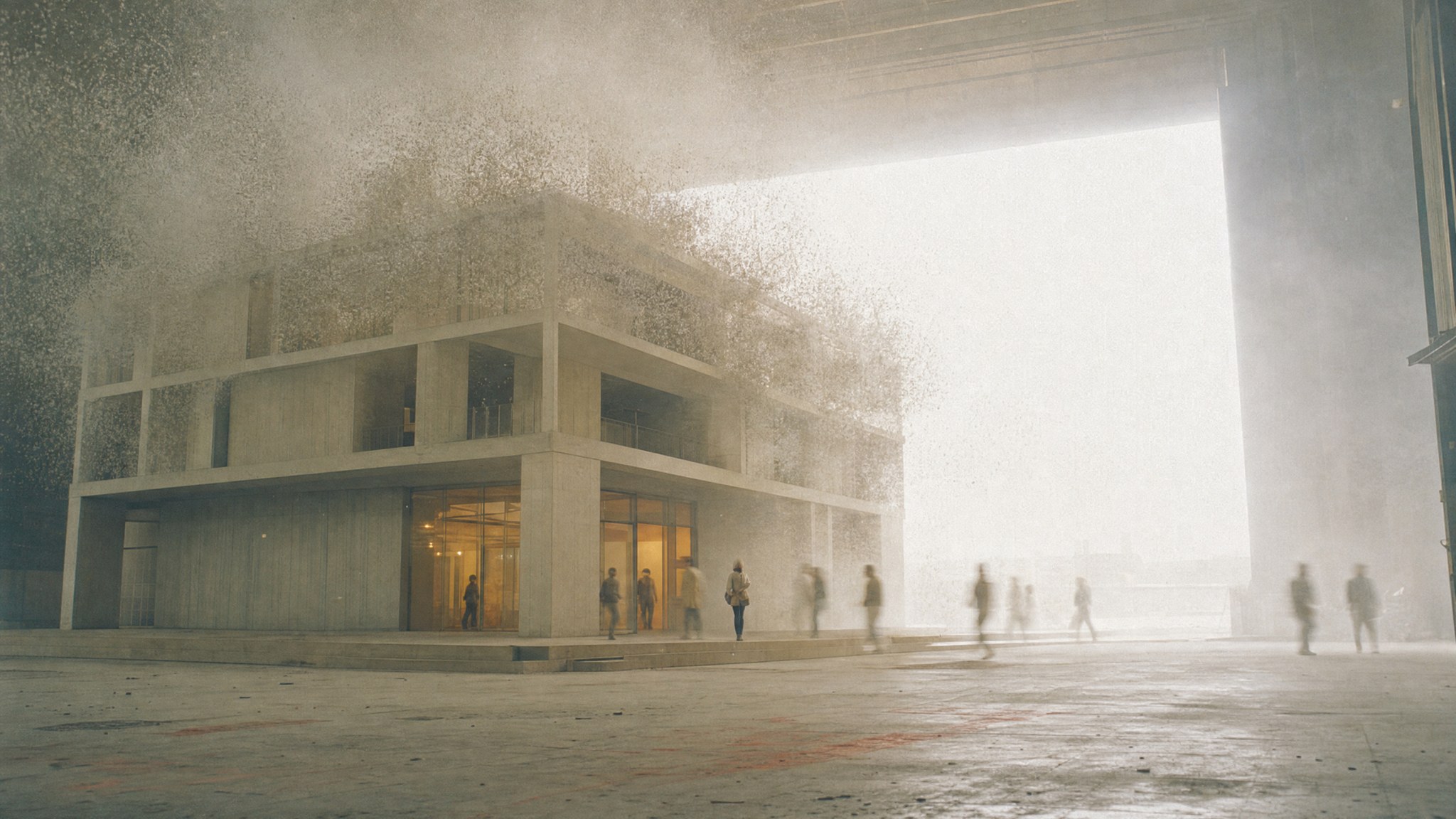
The visualisation industry has become extraordinarily good. A render today is indistinguishable from a photograph, produced quickly, revised endlessly, and priced as a commodity. Every serious project has them, which is exactly the problem.
A render answers the question what will it look like. That question was worth a great deal when it was hard to answer. Now that everyone can answer it, it has stopped being the question that decides anything.
What the render cannot do
A still image has no time in it. Which means it cannot show sequence, and sequence is where meaning lives in architecture. The experience of a building is not a view. It is arriving, passing through a compression, coming out into height, turning a corner and finding light where you did not expect it.
Architects know this. It is the entire discipline. And then the project is communicated with a set of static hero views taken from positions no human being will ever stand in, at a golden hour that lasts eleven minutes a day.
You are not selling a view. You are selling twenty minutes of someone's life inside a place that does not exist yet.
The three things film adds
- Time. The building unfolds in the order a person would meet it, which is the only order that matters.
- Occupation. People in the space, behaving normally, at the density the project is designed for. An empty render is an argument. An inhabited sequence is evidence.
- Sound. The acoustic character of a place is half its emotional signature, and it is completely absent from every render ever produced.
Why sound is the one nobody expects
Ask anyone to describe a hotel lobby they loved and they will mention how quiet it was, or the way the noise of the street dropped away at the door. Ask them to describe a building they disliked and you will often get a complaint about echo, or air conditioning, or the sound of a floor.
None of this is in the drawings and none of it is in the render. In a film it is unavoidable, which is a gift, because it lets you make a claim about the experience of a place that your competitors literally cannot make in their medium.
Who this is actually for
There are two audiences and they need different films, which is where most project films go wrong by trying to be one thing.
The investment audience is deciding whether to commit capital to something that does not exist. They need to believe the project has a coherent identity that will still be legible in four years, that it belongs to its site, and that there is a defined person who wants to be there. Their film is about conviction and specificity.
The buyer or guest audience is deciding whether they want to be in it. They need to feel a morning, an arrival, an evening. Their film is about occupation and desire. It should be almost entirely free of information.
The mistake that costs the most
Trying to serve both audiences with one film produces a piece that narrates specifications over aspirational imagery. It is the default output of the sector and it works on nobody. The investor does not need the mood and the buyer does not want the floor count.
Two films from one production is almost always cheaper than one film that fails twice.
The discipline this requires
A film of an unbuilt place is a claim about a future. It has to be made carefully, and there is a line between showing an intention and making a promise. Materials that are not specified, views that will be blocked by a neighbouring plot, amenities not yet approved: these belong in a conversation about what is illustrative, not in a film presented as documentation.
This is not a legal footnote, it is a craft constraint. It shapes what you shoot. A film that is honest about what is settled and what is intended is also a more persuasive film, because specificity where you have it reads as confidence, and vagueness where you do not reads as care.
How we build these, and the questions we ask before starting, are on the unbuilt projects page.
A render answers what it looks like, which is no longer the question that decides anything. Film adds time, occupation and sound, and it needs to be built separately for the investor deciding on conviction and the buyer deciding on desire.
If you have a project in approvals, in capital raise, or heading to a launch, that is the moment this is worth doing.
Talk to us