Not a trailer
A trailer markets a film that exists, to people who might buy a ticket.
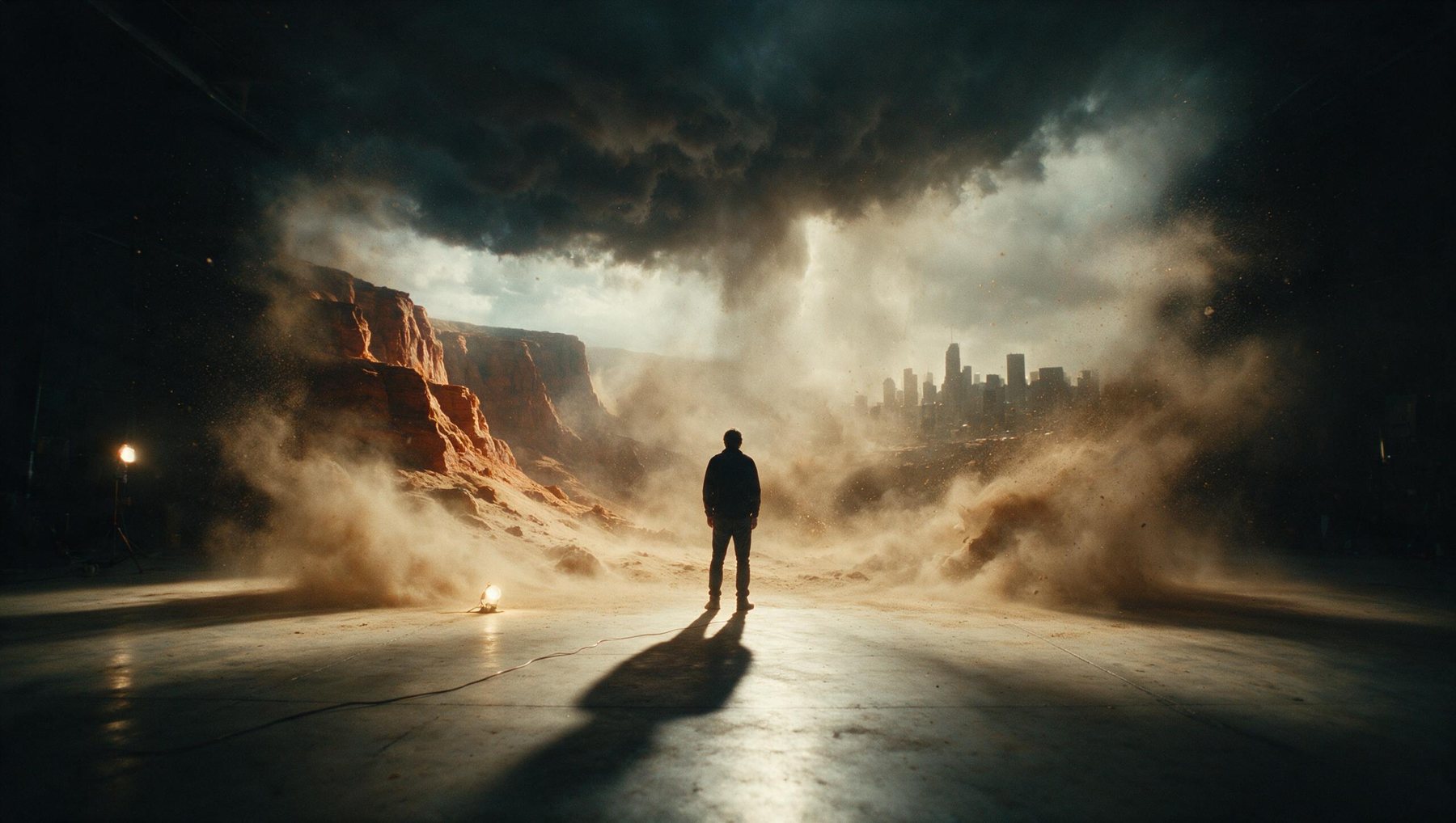
The industry standard for pitching an unmade film is a mood reel: clips from other people’s movies, cut together, while you ask the room to imagine yours. We film yours instead.
The script, the mood reel, the line. Then your film.
A proof of concept sells an unfinished thing to a decision maker. It demonstrates the vision, the tone and the viability of a project before the money exists, and it is built for one person: the one who has to say yes.
A trailer markets a film that exists, to people who might buy a ticket.
Previz answers how to shoot it, after the money is in. This answers whether it deserves the money at all.
Nobody has ever been moved by a capabilities reel.
A mood reel borrows someone else’s images. It proves your taste. It cannot prove your film.
Every piece proves one or two. A film that tries to prove all six proves nothing. Execution is always the second proof, whether you choose it or not.
Does this universe hold up on screen, or does it fall apart the moment it stops being described?
Can this protagonist carry ninety minutes?
What is the emotional experience? Genre before the first line of dialogue.
Does it look like cinema, or like a small idea with ambition?
Is there an imaginable audience, and does the piece speak their visual language?
Can this team actually pull it off? Nobody asks. Everybody judges.
Half the value of a proof of concept can be that it proves you. Directors have been hired off two minute shorts made for a few hundred dollars, and what changed hands was the person, not the premise. So we ask first, and we write the answer into the contract.
We work as your production partner. The film is yours end to end.
Your vision, our direction and execution alongside it.
When you would rather hand us the authorship.
Three to eight minutes for a scene. Sixty to one hundred and twenty seconds for a concept trailer. The classic advice says five to fifteen minutes, and attention has moved since. The piece ends when the proof is finished, not when the material runs out.
A scene proves the film works. A trailer proves the world does. If the doubt in the room is whether the story holds, shoot the scene. If it is whether the world and the tone justify the budget, cut the trailer. Choosing the wrong one is the most expensive mistake in this category.
Treat it as a development and financing tool, not a festival submission. Cannes ruled generative AI ineligible for its Official Competition in 2026, and SXSW and Tribeca require disclosure. We put in writing how your piece was produced, so you are never the last to know.
Every project is quoted on its own terms: scope, complexity, rights, deadline, and what the piece has to carry. What changes with us is what a budget buys. Not one scene in one location, but the whole world of the film.
Tell us what does not exist yet, who has to decide, and when the meeting is.
Start a project →Or see unbuilt projects →