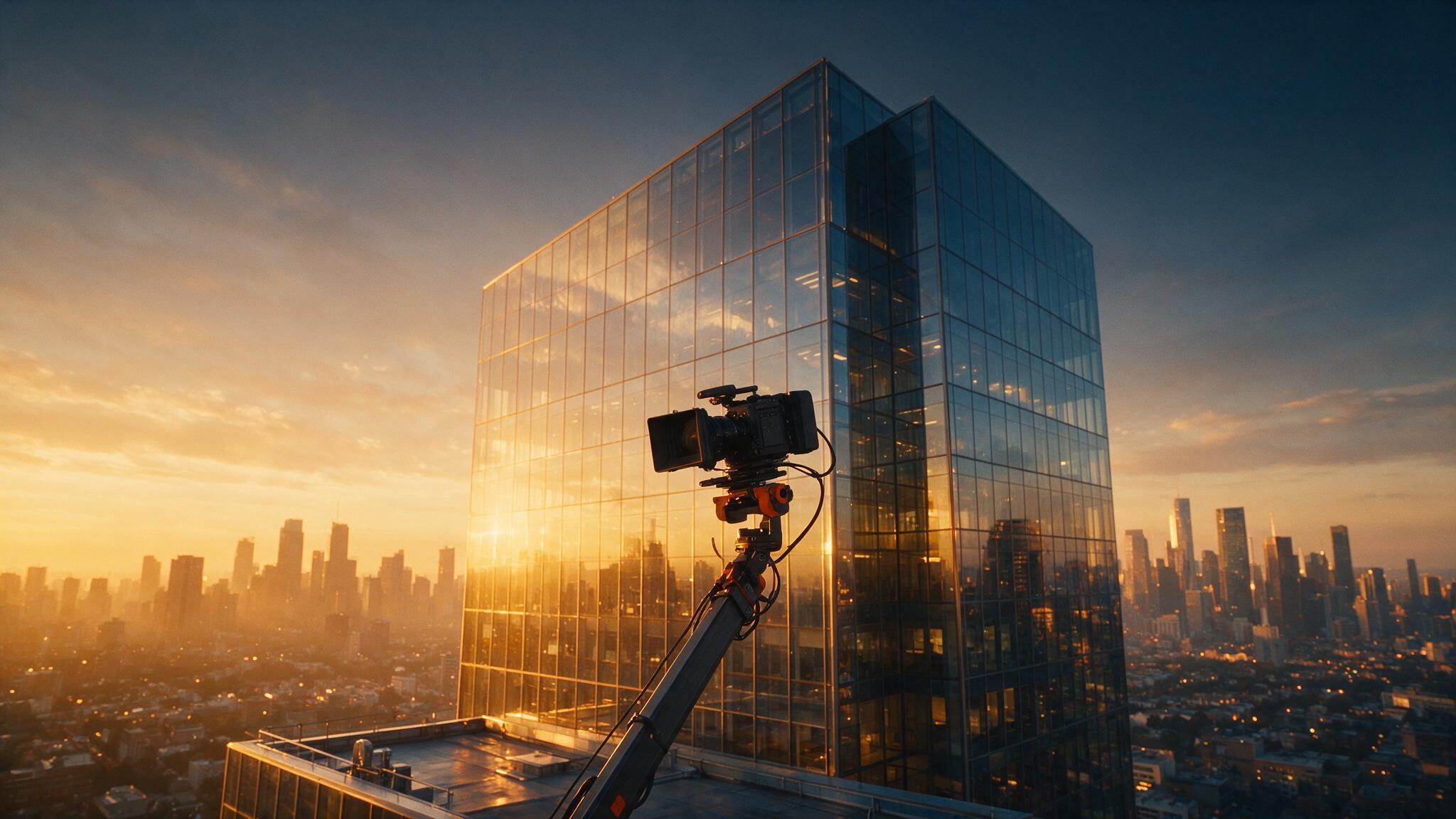
There is a specific kind of dead footage everyone recognizes and nobody names: the AI corporate video. Glass towers at golden hour. A slow generic drone push. People in blazers nodding in a meeting room made of light. Technically clean, emotionally nothing.
We make corporate films with AI every month, and we have watched exactly where the flatness comes from. It is not the engine. It is the words we feed it and the shots we fail to design. Here is the diagnosis and the fix.
Why the AI corporate video looks flat
Run this experiment, as we did in our lab. Take a decent institutional shot and prompt it with the words every brief reaches for: corporate, clean, professional, modern, polished.
The engine obeys. That is the problem. Those words are locks. Each one tells the model to sand off risk: no shadow too deep, no face too close, no camera move with intent. Stack five safety words and you have instructed the machine to produce the average of every corporate video ever made. The average is flat by definition.
The engine did not fail. It delivered exactly the beige you asked for. In our lab we call these prompt locks, and removing them is the first direction decision on any corporate film. Replace category words with sensory ones. Not "professional office environment" but "morning light through industrial glass, one person mid-thought." The engine renders images, not adjectives from a brand deck.
How an AI corporate video becomes cinema
Unlocking the prompt gets you to neutral. Two direction moves get you to cinema. Both came out of our own production room, on real institutional films, and both cost nothing extra to generate.
The camera altitude arc
Flat corporate videos keep the camera at one respectful distance for the entire film, like a visitor who was told not to touch anything. Cinema moves through altitudes.
Design the film as an arc of heights: open wide and high, where the company lives in its landscape. Descend to human height, where the work actually happens. Drop to detail, hands, material, texture, the thing being made. Then rise again for the close, so the ending feels earned rather than appended.
When we started planning corporate films as altitude arcs instead of shot lists, the same footage budget started producing films that feel like they go somewhere. Because they literally do: the camera has a journey, so the viewer has one.
The 1.5 second face
Here is the smallest, highest-leverage move we know. In our lab we found that holding a human face, still, doing nothing, for about a second and a half, works like punctuation. It is the comma in the sentence of the film.
Machines, buildings and infographics carry information. A held face carries belief.
Corporate videos are terrified of this shot. A face not smiling at the camera, not gesturing at a whiteboard, just being a person for a beat, feels like dead air in the edit room. On screen it is the opposite: it is the moment the viewer attaches. One per film, placed where the message turns, changes everything around it.
Practical rules from our production room
Beyond the two big moves, the habits that keep an AI corporate video from sliding back into flatness:
- Generate at native 1080p. Upscaled 720p reads as soft, and soft reads as cheap. We tested it side by side and stopped arguing about it.
- Design longer shots, cut later. Engines bill a 4 second minimum per clip, so a film built from ten tiny fragments pays a fragment tax and feels fragmented too. Fused shots are cheaper and more cinematic at once.
- Sound is not a music bed. Room tone, a real mix, silence used on purpose. Half the perceived production value of a corporate film is in the audio nobody consciously hears.
- One idea per film. The flat corporate video usually has seven messages from seven stakeholders. Cinema has one.
None of this requires a bigger engine budget. It requires someone deciding. Which is the honest secret of AI corporate video in 2026: the tools are now good enough that flatness is a direction failure, not a technology limit.
AI corporate videos look flat because of prompt safety words and undesigned shots, not the engine; a camera altitude arc and one held human face turn the same budget into cinema.