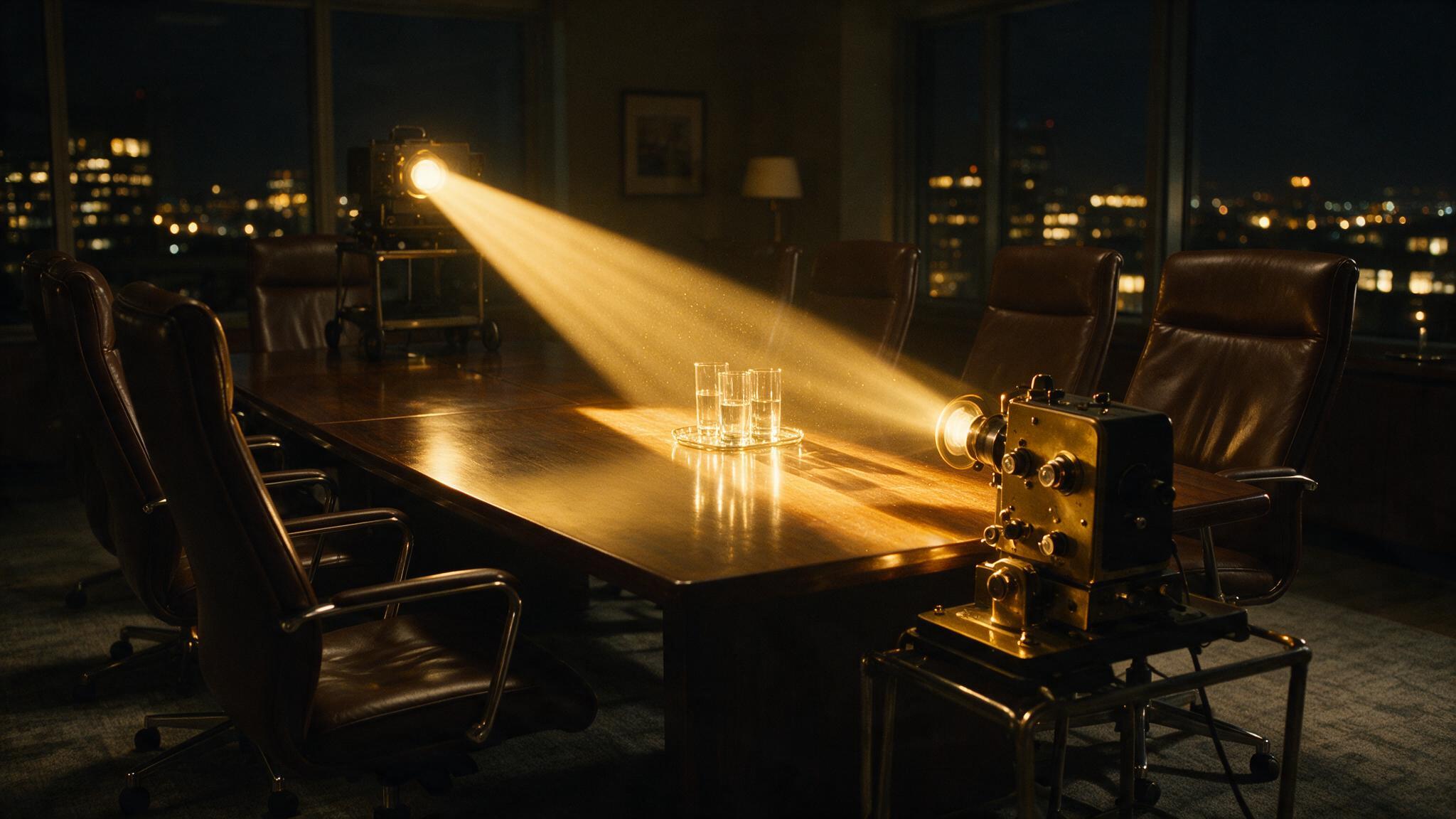
An investor sees hundreds of decks a month. A deck is a document that asks for effort: read me, infer the energy, imagine the scale. A film does the opposite. It hands over, in three minutes, the thing a deck can only describe: what this company feels like when it wins. That used to cost a production budget only funded companies could afford, which was a cruel joke, because the companies who most need to look fundable are the ones still raising. AI production broke that loop. We produce investor pitch films in days, and they are viable now for any company raising internationally.
What an investor pitch video has to do in 3 minutes
Three minutes is not a constraint we grumble about. It is the correct length. Longer and you are testing patience; shorter and you are a teaser without an argument. Within it, the structure that works is old, honest and ruthless: problem, vision, traction.
- Problem, roughly the first minute. Not a market statistics recital. A felt problem, staged so the viewer experiences the friction rather than being told it exists. If the investor does not nod in the first sixty seconds, the rest is decoration.
- Vision, the middle. What the world looks like with your company in it. This is where AI production earns its keep, because you can show the future operating: the product at scale, the customer in the changed world, the infrastructure that does not exist yet. A deck says imagine. A film removes the need to.
- Traction, the close. Numbers, names you can disclose, momentum. Delivered plainly, because after two minutes of cinema, restraint reads as confidence. The companies that shout their traction are usually compensating.
Then it ends. No montage victory lap. The last frame should leave a question in the room, and the question should be when can we talk?
Fundraising video for international rounds
Here is the case that gets underweighted: if you are raising outside your home market, a film is not a nice-to-have, it is a translation layer. An investor in Dubai or London evaluating a company from São Paulo, Lagos or Jakarta is bridging distance, accent, context and skepticism all at once. A written deck makes them do that bridging alone.
Your best three minutes attend every internal meeting you are not invited to.
A film does it for them. Production quality is read, fairly or not, as a proxy for operational quality. A precise, cinematic three minutes says: this team can execute to an international standard. That signal lands before a single metric does. We have built pieces exactly like this for founders raising abroad, and the film's first job was never the content. It was permission: proof the company belongs in the room.
There is a second, quieter advantage. A film is forwardable. A partner who liked your meeting cannot re-perform your pitch to the committee, but they can press play.
Why AI production changes the fundraising math
The traditional blocker was never the idea for the film. It was the production reality: crews, locations, weeks of post, and a bill that looked irresponsible on a pre-raise budget. AI production collapses that:
- Days, not months. Our pipeline runs research, script, storyboard with animatic, directed generation, designed sound and voice, delivery. For a pitch film, that cycle fits inside a week when the founders are responsive.
- Show what does not exist yet. Your product at a scale you have not reached, deployed in markets you have not entered. This is legitimate vision-casting, not fabrication, and the line between the two is a direction decision we take seriously: traction is only ever real numbers.
- Revisable per audience. Raising in two regions? The film can be re-versioned, reordered, re-voiced for each room, because the assets are regenerable, not locked in footage.
One discipline note from production: the strategy in the film is always yours. Our research on your market becomes ammunition for the conversations we have with you, never a script we impose. Investors fund founders. A film that sounds like an agency wrote the company's thesis is detectable in one meeting, and it detonates exactly when the founder has to continue the story live.
What separates a pitch film from a pretty video
Three criteria we hold every cut against:
- Could a competitor put their logo on it? If yes, it is not your film yet. Specificity is the whole game.
- Does every shot advance the argument? A pitch film is rhetoric with pictures. The animatic stage exists to prove the rhythm of the argument before a single frame is generated.
- Does the founder recognize themselves in it? The film warms the room; the founder closes it. If the film's voice and the founder's voice diverge, the meeting starts with a credibility gap.
Beauty is table stakes. The film works when the argument works.
A pitch film is rhetoric with pictures: problem, vision, traction in three minutes, produced in days with AI, and it works when the argument works, not when the shots are pretty.