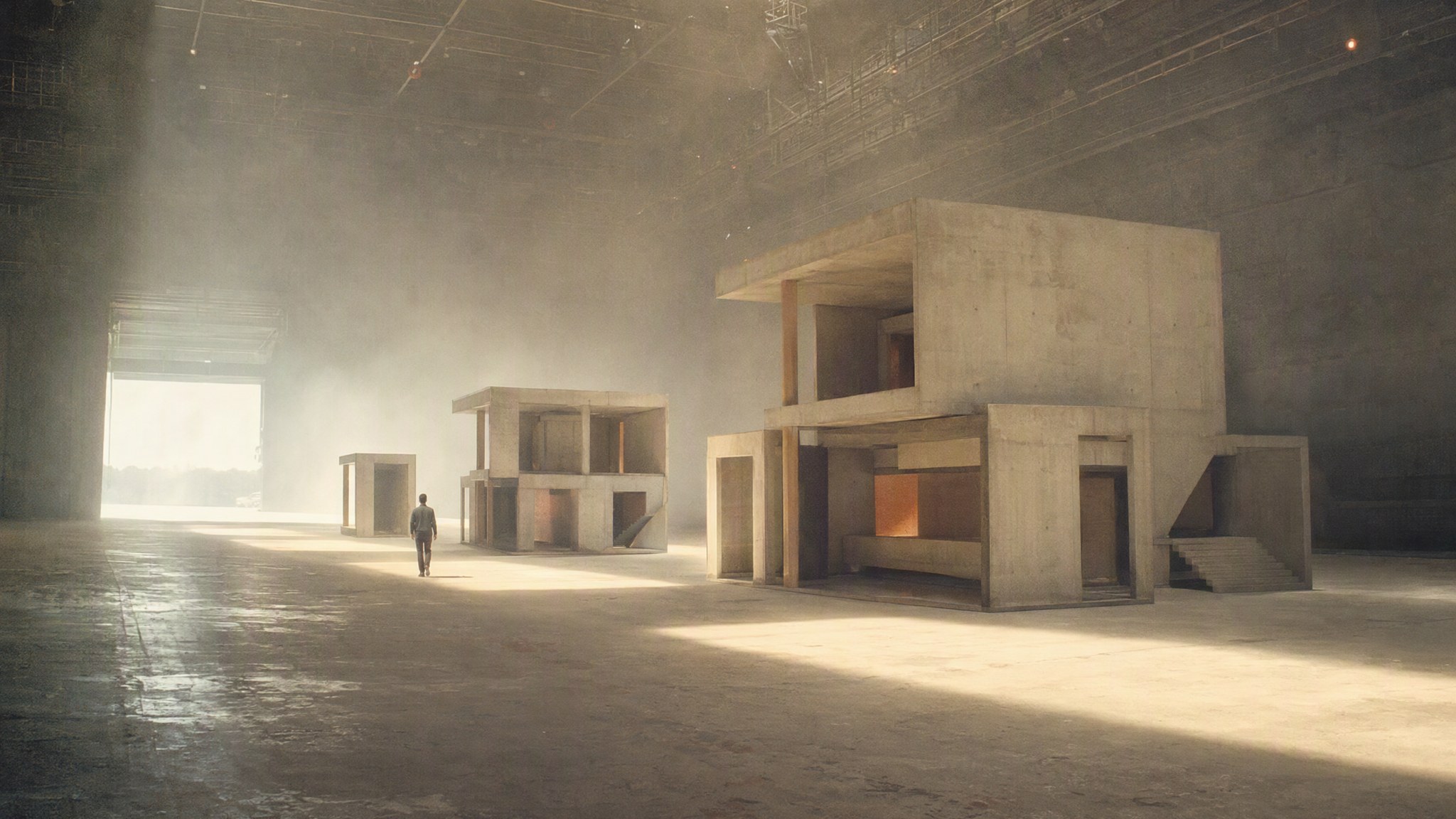
The honest answer is that duration is an output, not an input. You do not pick ninety seconds and then find out what fits. You decide what has to be proven, and the proof tells you how long it takes.
That said, proofs cluster, and after enough of them three lengths keep appearing.
Around sixty seconds: proving a world
If the gap is visual, a minute is usually enough and often better than more. World is established quickly and then confirmed. What you need is a handful of shots that could not have come from anywhere else, and a sense that the place continues past the frame.
The failure mode at this length is the montage. A minute of beautiful disconnected images proves that images can be made. It does not prove that a world exists, because a world is a set of rules, and rules only become visible when something obeys them across a cut.
Ninety seconds to two minutes: proving a tone
Tone is the most common gap and the most demanding one. It cannot be established, only sustained, because tone is what happens between events. A joke that lands is not proof of a comedy. A comedy is proved when a joke lands, the film keeps its footing, and the next beat lands too.
That needs a scene with a beginning, a change and an end. Under ninety seconds you are usually showing a moment rather than a scene, and moments are exactly what a skeptical viewer discounts.
Three to five minutes: proving that it plays
The longest useful format, and the rarest. This is a full sequence, played out, with the pacing the finished film would have. You use it when the doubt is not about look or tone but about whether the thing holds attention at all.
It is also the most dangerous length, because you no longer have the protection of speed. Every weakness is visible. That is the point. If the sequence survives five minutes with a stranger, you have removed the largest doubt there is, and you have removed it in a way no shorter film could.
Things that do not determine length
- The budget. A longer film is not a better use of the same money. It is often a worse one, because the same resources get spread thinner and the weakest shot sets the perceived level.
- The runtime of the finished project. A feature does not need a longer proof than a short does.
- What another project did. Their gap was not your gap.
- The desire to include a favourite scene. That is the most expensive line item in the category.
The rule that matters more than duration
The strongest predictor of whether a proof of concept works is not how long it runs. It is whether it sustains. A ninety second film built from three shots that each hold their ground beats a three minute film that never stops cutting, because cutting is how you hide, and the viewer knows it.
So the real question behind how long should it be is how long can it hold. Build to the longest duration your material can sustain without flinching, then stop there. Anything past that point is not more proof, it is exposure.
The practical constraint nobody mentions
It will be watched on a laptop, probably not full screen, probably with the sound low, probably between two other things. That is not a reason to make it shorter. It is a reason to make sure the proof is present in the first fifteen seconds and again later, so a distracted first viewing still lands, and the second viewing, which is the one that matters, has something to reward it.
How we decide duration on a real project is part of the diagnosis stage described on the proof of concept page.
Duration is decided by the proof, not by convention: about a minute for a world, ninety seconds to two minutes for a tone, three to five for whether it plays at all. Build to the longest length your material can sustain without cutting to hide, then stop.
Tell us what you need to prove and we will tell you how long it takes, before any numbers are discussed.
Start there