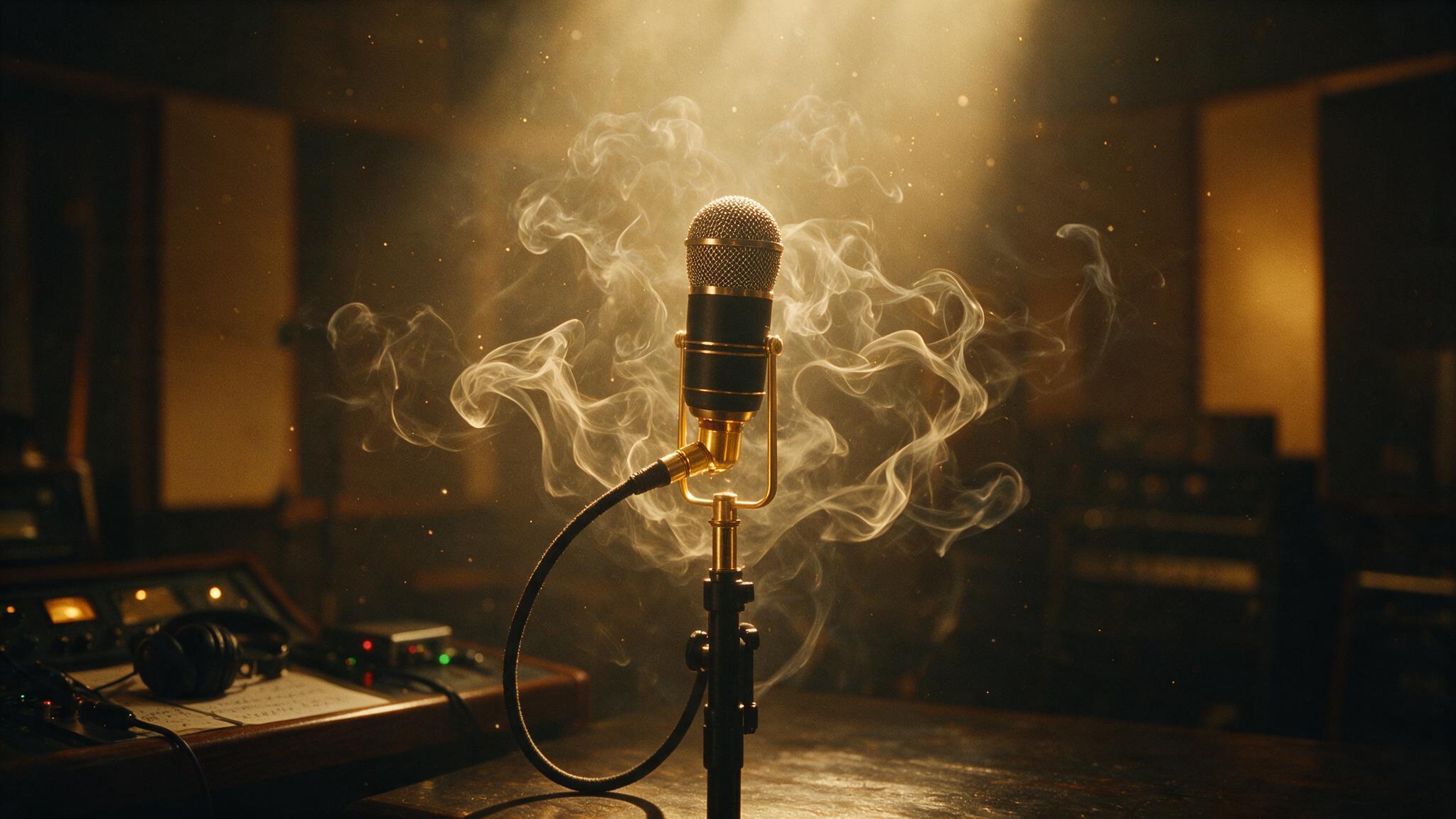
Close your eyes and think of the brands you trust. You can probably see their logos. Now try to hear them. For most brands, there is nothing there. Silence. And yet every video they publish has a voice in it, chosen in the last ten minutes of production, usually described with a single word: "professional."
That silence is a missed asset. At KURACONV, voice is not the final step of a video. It is one of the first decisions of the brand. Here is the argument, and the workflow that follows from it.
The afterthought problem with AI narration
The default pipeline in most teams looks like this: write the script, generate the visuals, edit the cut, and then, at the end, open a text-to-speech tool and audition presets until one sounds acceptable. The voice is treated as a delivery mechanism for words, a subproduct of the video.
The result is narration that fights the film. The pacing of the read never matches the pacing of the edit, because the edit was locked before the voice existed. The energy is generic, because the voice was chosen from a menu instead of designed for a purpose. And across ten videos, the brand sounds like ten different companies, because each editor picked whatever preset was nearest.
Audiences register this even when they cannot name it. Sound reaches emotion faster than image. A film can look expensive and still feel cheap the second the narration starts.
Voice-first: how we actually build
In our workflow, the voice is designed before the video is built, and the video is constructed around it. Not the script. The voice itself: timbre, pace, accent, breath, the temperature of the delivery.
This inverts everything downstream, and the effects are practical, not poetic. When the voice exists first, the edit inherits its rhythm. A slow, warm voice produces longer shots and softer transitions, because cutting fast against it feels wrong in the timeline. A clipped, precise voice earns tighter framing and harder cuts. The voice becomes the metronome of the film, which is exactly what a human director does with a lead actor's performance.
Our method, Sentimagem, frames it simply: mood coherence comes before anything is revealed on screen, and voice is the fastest channel to feeling. Choosing it last means choosing the feeling last, which means never really choosing it.
Designing an AI voice with ElevenLabs
Modern voice engines made this workflow possible for studios of any size. We work extensively with ElevenLabs, and the craft lives in the parameters most people never touch.
Timbre is the identity layer: how dark, how bright, how much texture in the tone. This should map to brand personality the same way a typeface does. Pace is the confidence layer: brands that rush sound like they are selling, brands that breathe sound like they are stating. Accent is the belonging layer, and it deserves real thought for global brands. A neutral international accent reads differently in São Paulo, London and Dubai, and sometimes a rooted accent is precisely the point.
Then there is consistency, which is where AI narration quietly beats traditional voiceover. A designed voice never has a cold, never ages, never books another gig. The five-second product clip and the three-minute brand film share the exact same vocal identity, indefinitely. That repetition is how sonic branding compounds: the voice becomes recognizable before the logo appears.
A lab note on voice and picture
One finding from our production tests is worth sharing. When we generate video first and add narration after, iteration is expensive: every script change fights a locked edit. When the voice track exists first, iteration gets cheap. We adjust a read, and the edit flexes around it in minutes, because the visual language was built to serve the voice from the start.
There is also a casting insight. Auditioning a voice against a storyboard reveals problems no spec sheet catches. A voice that sounded authoritative in isolation can turn cold against warm imagery. We test voice and image together at the animatic stage, before any expensive generation, the same way a film director screen-tests an actor.
What this means if you are building a brand
Three takeaways you can apply tomorrow.
- Treat voice selection as a brand decision, made once, documented like a palette. Write down the timbre, the pace, the accent, and the feelings each choice serves, so no editor ever picks a preset again.
- Design the voice before producing your next batch of videos, not after. Even if the videos are simple, the sequencing changes their quality.
- Audit what you already have. Play your last five videos back to back with the screen off. If they sound like five different companies, you have found real brand equity lying on the floor.
Sound reaches emotion faster than image. A film can look expensive and still feel cheap the second the narration starts.
Design the voice before the video and the whole film inherits its rhythm: voice is a brand element like a palette or a typeface, not a preset picked in the last ten minutes of the edit.